

The Next Chapter of Intelligent Home Infrastructure: Working with Solar and Batteries

The Next Chapter of Intelligent Home Infrastructure: Working with Solar and Batteries

By
Cala Systems
|
October 7, 2026

Today, we’re announcing the next phase of Cala’s development: continuous Solar Sync and Battery Sync. Coming in Q4, these capabilities will let Cala respond to real-time information from your solar and battery systems, adapting how and when it heats water as prices and conditions in your home change.

This launch marks a major leap forward for intelligent home infrastructure: solar, batteries, and water heating working as a team to lower energy costs, strengthen resilience, and keep hot water ready when it’s needed.

Customers are already looking forward to that coordination. As one shared in a recent survey: “The Home Assistant/MQTT integration and TOU scheduling have been a highlight… I’m also looking forward to the solar and battery coordination features.” This launch takes that next step, giving Cala the capability to work in lockstep with solar and battery systems.

A Macrotrend to Variable Pricing

Across the United States, there is a clear movement to phase out traditional 1:1 retail net metering for solar customers in favor of net billing structures and time-of-use (TOU) rates. Under these modernized frameworks, excess rooftop solar exported during peak production hours is credited at significantly lower wholesale "avoided cost" rates—often a 70–80% reduction from retail prices—while electricity consumed during high-demand evening windows carries steep premium prices. This nation-wide policy evolution shifts homeowner economics toward self-consumption, as these two examples illustrate:

Duke Energy’s Residential Solar Choice program in North Carolina combines solar billing with time-of-use and critical-peak pricing, with prices as low as $0.08 per kWh in the midday and as high as $0.45 during times of peak demand.

In Sacramento, SMUD’s summer 2026 rates paid Solar and Storage Rate customers 9.6¢ per kilowatt-hour for exported solar, while its standard time-of-day plan charged 37.65¢ during weekday evening peaks—nearly four times as much. That roughly 28¢ gap illustrates the opportunity to store afternoon solar as hot water for later use.
Sources: North Carolina Public Staff, SMUD export credits, and electricity rates.

The movement to variable pricing also drives the widespread adoption of battery systems, with the ‘battery attachment rate’ typically rising from ~10% to ~60-80% in regions that make the shift. Market leader SunRun illustrates this trend, with its battery attachment rate rising from ~15% in 2020-2021 to ~70% in 2026.

Cala Joins the Solar and Battery Team

Cala already plans water heating around anticipated hot water demand, electricity prices, and forecast solar availability. Continuous Solar Sync lets it adjust that plan moment by moment using real-time information from the home, storing available energy as hot water for later.

For homes with solar, with or without a battery, Cala can respond when surplus electricity flows toward the grid, running its heat pump to capture that energy as hot water. Where export credits are lower than the cost of buying electricity later, this can help reduce energy costs while making more use of the home’s solar production.

For homes with batteries, Battery Sync adds another layer of coordination. Homeowners can choose the battery charge levels at which Cala starts and stops storing extra heat—for example, beginning at 90% charge and stopping that additional heating below 75%. Cala can also use surplus solar when production exceeds what the battery can absorb.

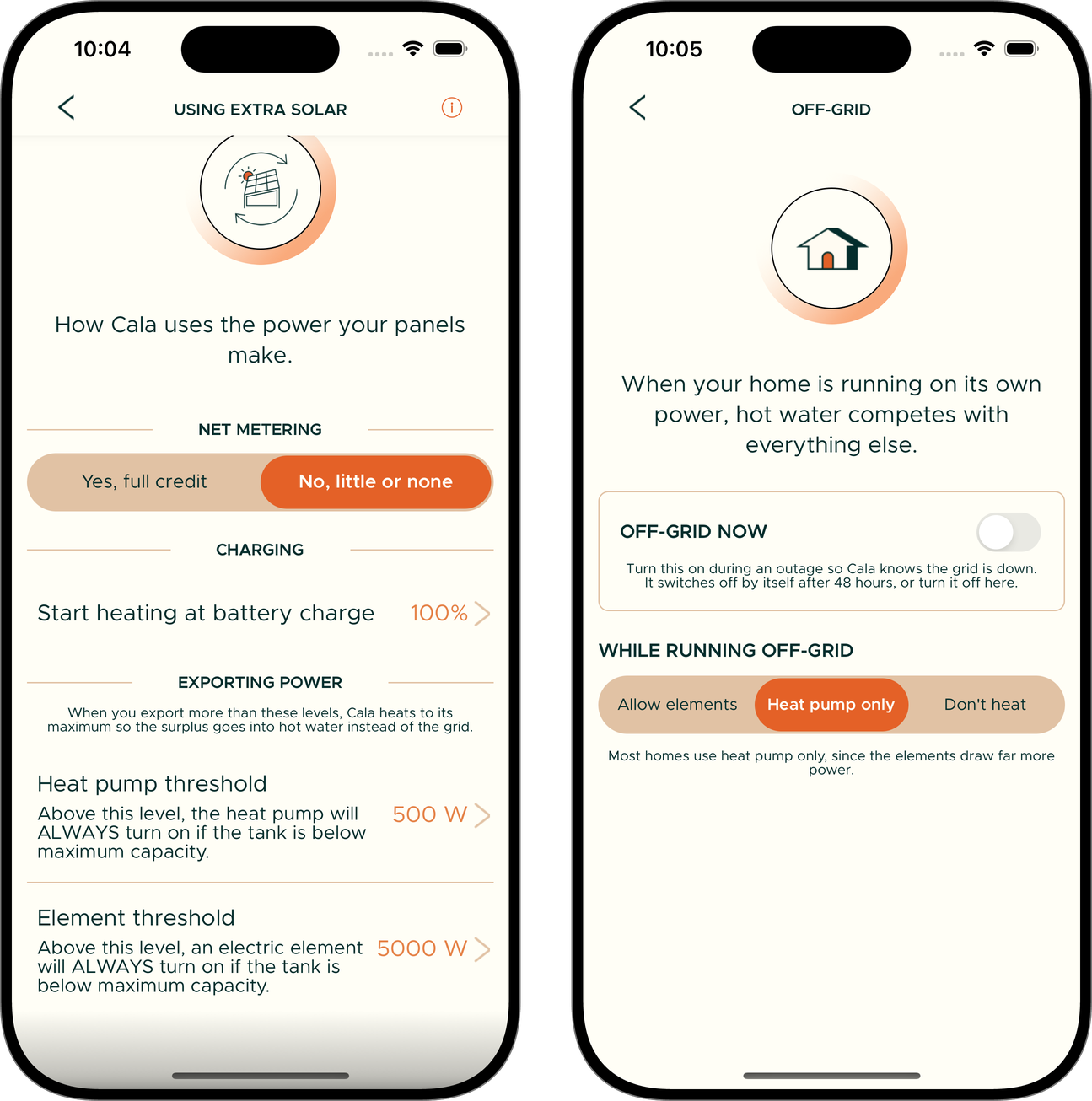
That coordination supports greater resilience during outages. When a connected system reports a loss of grid power, Cala can follow the homeowner’s chosen settings: use only the heat pump, allow backup heating elements, or pause heating to conserve electricity. Homeowners can also enable off-grid mode manually.
Hot water stored ahead of time helps preserve comfort while leaving more battery power available for other household needs.

Throughout, Cala’s core responsibility remains the same: having hot water ready when your household needs it, with more flexibility in how it uses the energy available.

Coming to Your Home in Q4

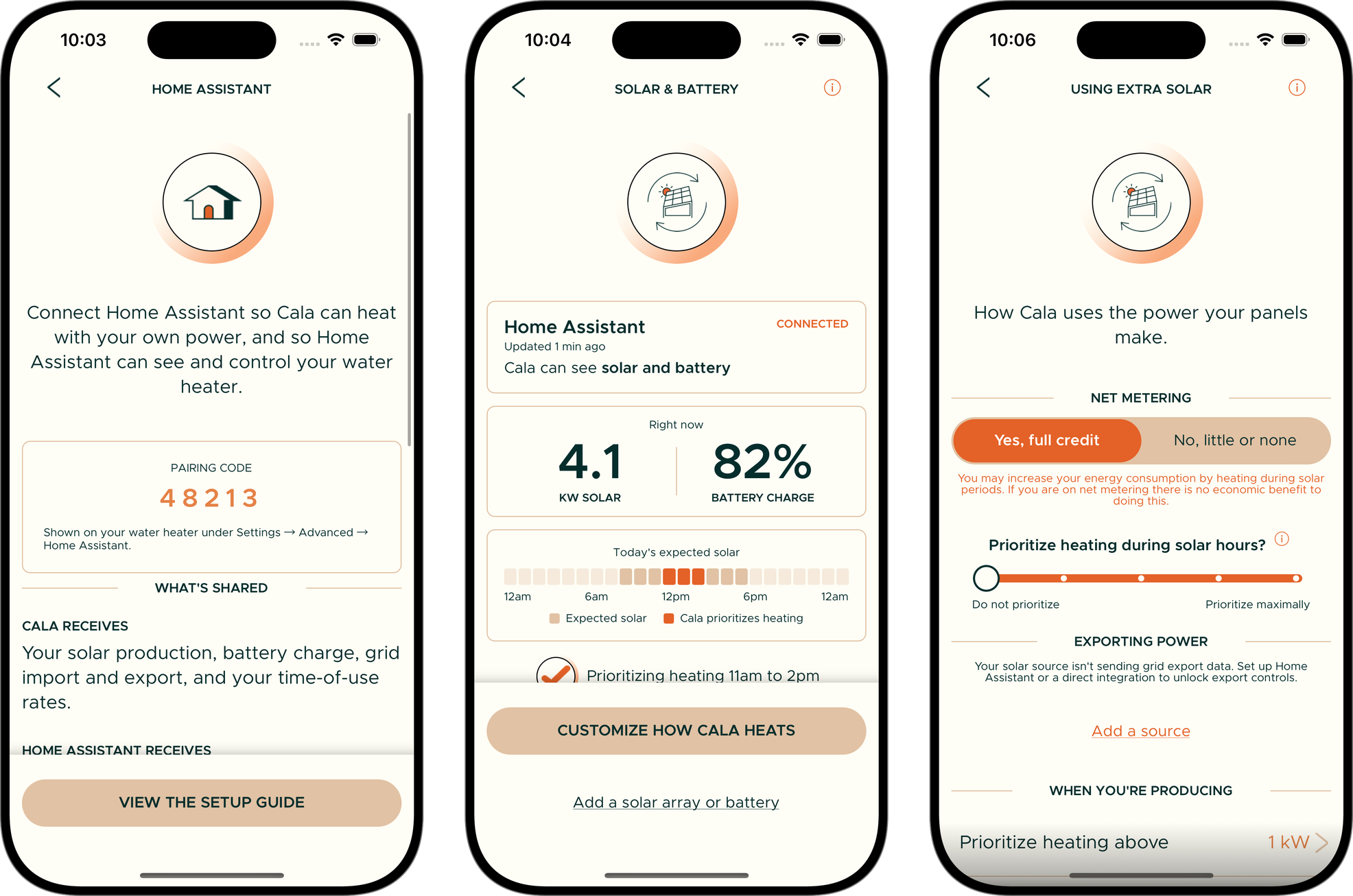
Continuous Solar Sync and Battery Sync will launch in Q4, initially through Home Assistant, for homes with solar—with or without a battery. Supported setups will let Cala receive real-time solar production and grid-flow data, with battery charge information available for homes that also have storage.

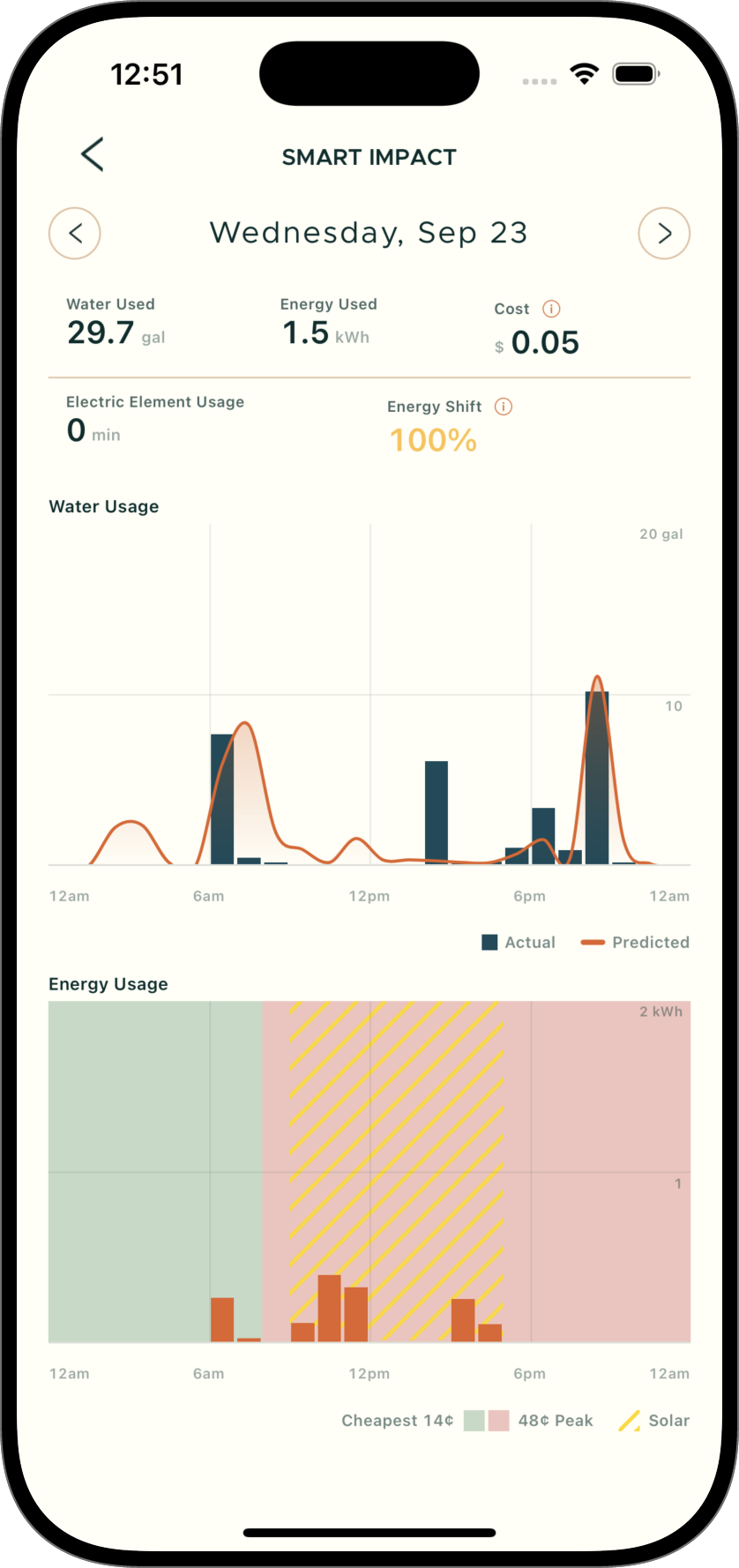
The updated Cala app will show solar production alongside the expected production window, plus battery charge where applicable.

Cala’s defaults will handle everyday decisions automatically, while homeowners can tailor how it uses surplus solar and, where a battery is present, conserves backup power during an outage.

Cala also accounts for your electricity rate structure and lets you choose how strongly to prioritize heating during solar hours.
The goal is a system that manages the details while reflecting your household’s priorities.

Direct connections to individual inverter and battery brands will follow, bringing these capabilities to more homeowners without requiring Home Assistant. Homeowners will be able to tell us which systems they own to help inform integration priorities.

We’ll announce each integration as it becomes available and share setup guidance with Cala owners at launch.

This is the Future of Home Solar

Approximately 3 million homes have solar with net billing or mandatory TOU rates today, and this number will more than double by 2030, reaching roughly 7 million homes. For these homeowners, making their water heater work with the solar and battery system is an immediate opportunity to deliver greater savings, resilience, and comfort. It’s also common sense — homeowners are asking for this synchronization, and Cala is bringing it to them.

Solar, batteries, and water heating will increasingly operate as one coordinated home energy system. That is the direction of intelligent home infrastructure and with continuous Solar Sync and Battery Sync, Cala is taking a major step in making it a reality.

Share this post

Today, we’re announcing the next phase of Cala’s development: continuous Solar Sync and Battery Sync. Coming in Q4, these capabilities will let Cala respond to real-time information from your solar and battery systems, adapting how and when it heats water as prices and conditions in your home change.

This launch marks a major leap forward for intelligent home infrastructure: solar, batteries, and water heating working as a team to lower energy costs, strengthen resilience, and keep hot water ready when it’s needed.

Customers are already looking forward to that coordination. As one shared in a recent survey: “The Home Assistant/MQTT integration and TOU scheduling have been a highlight… I’m also looking forward to the solar and battery coordination features.” This launch takes that next step, giving Cala the capability to work in lockstep with solar and battery systems.

A Macrotrend to Variable Pricing

Across the United States, there is a clear movement to phase out traditional 1:1 retail net metering for solar customers in favor of net billing structures and time-of-use (TOU) rates. Under these modernized frameworks, excess rooftop solar exported during peak production hours is credited at significantly lower wholesale "avoided cost" rates—often a 70–80% reduction from retail prices—while electricity consumed during high-demand evening windows carries steep premium prices. This nation-wide policy evolution shifts homeowner economics toward self-consumption, as these two examples illustrate:

Duke Energy’s Residential Solar Choice program in North Carolina combines solar billing with time-of-use and critical-peak pricing, with prices as low as $0.08 per kWh in the midday and as high as $0.45 during times of peak demand.

In Sacramento, SMUD’s summer 2026 rates paid Solar and Storage Rate customers 9.6¢ per kilowatt-hour for exported solar, while its standard time-of-day plan charged 37.65¢ during weekday evening peaks—nearly four times as much. That roughly 28¢ gap illustrates the opportunity to store afternoon solar as hot water for later use.

Sources: North Carolina Public Staff, SMUD export credits, and electricity rates.

The movement to variable pricing also drives the widespread adoption of battery systems, with the ‘battery attachment rate’ typically rising from ~10% to ~60-80% in regions that make the shift. Market leader SunRun illustrates this trend, with its battery attachment rate rising from ~15% in 2020-2021 to ~70% in 2026.

Cala Joins the Solar and Battery Team

Cala already plans water heating around anticipated hot water demand, electricity prices, and forecast solar availability. Continuous Solar Sync lets it adjust that plan moment by moment using real-time information from the home, storing available energy as hot water for later.

For homes with solar, with or without a battery, Cala can respond when surplus electricity flows toward the grid, running its heat pump to capture that energy as hot water. Where export credits are lower than the cost of buying electricity later, this can help reduce energy costs while making more use of the home’s solar production.

For homes with batteries, Battery Sync adds another layer of coordination. Homeowners can choose the battery charge levels at which Cala starts and stops storing extra heat—for example, beginning at 90% charge and stopping that additional heating below 75%. Cala can also use surplus solar when production exceeds what the battery can absorb.

That coordination supports greater resilience during outages. When a connected system reports a loss of grid power, Cala can follow the homeowner’s chosen settings: use only the heat pump, allow backup heating elements, or pause heating to conserve electricity. Homeowners can also enable off-grid mode manually.

Hot water stored ahead of time helps preserve comfort while leaving more battery power available for other household needs.

Throughout, Cala’s core responsibility remains the same: having hot water ready when your household needs it, with more flexibility in how it uses the energy available.

Coming to Your Home in Q4

Continuous Solar Sync and Battery Sync will launch in Q4, initially through Home Assistant, for homes with solar—with or without a battery. Supported setups will let Cala receive real-time solar production and grid-flow data, with battery charge information available for homes that also have storage.

The updated Cala app will show solar production alongside the expected production window, plus battery charge where applicable.

Cala’s defaults will handle everyday decisions automatically, while homeowners can tailor how it uses surplus solar and, where a battery is present, conserves backup power during an outage.

Cala also accounts for your electricity rate structure and lets you choose how strongly to prioritize heating during solar hours.

The goal is a system that manages the details while reflecting your household’s priorities.

Direct connections to individual inverter and battery brands will follow, bringing these capabilities to more homeowners without requiring Home Assistant. Homeowners will be able to tell us which systems they own to help inform integration priorities.

We’ll announce each integration as it becomes available and share setup guidance with Cala owners at launch.

This is the Future of Home Solar

Approximately 3 million homes have solar with net billing or mandatory TOU rates today, and this number will more than double by 2030, reaching roughly 7 million homes. For these homeowners, making their water heater work with the solar and battery system is an immediate opportunity to deliver greater savings, resilience, and comfort. It’s also common sense — homeowners are asking for this synchronization, and Cala is bringing it to them.

Solar, batteries, and water heating will increasingly operate as one coordinated home energy system. That is the direction of intelligent home infrastructure and with continuous Solar Sync and Battery Sync, Cala is taking a major step in making it a reality.
latest ARTICLES

Cala + Home Assistant: Water Heating That Responds to Your Home

Read Article

Cala Pro Spotlight: SumZero Energy Systems (Mass)

Read Article

Cala’s Intelligent Heat Pump Water Heater is Now Certified

Read Article

Employee Spotlight : Dustin Cox, Southeast Territory Manager.

Read Article