

Your Water Heater Will Outlast Your Utility Rate Plan

Cala Systems
August 8, 2026

Your Water Heater Will Outlast Your Utility Rate Plan

Cala Systems
August 8, 2026

Your Water Heater Will Outlast Your Utility Rate Plan

By
Cala Systems
|
August 8, 2026

The water heater you install today will likely still be in your home 10 to 15 years from now.

During that time, your home may change significantly. You might install solar panels, add battery storage, buy an electric vehicle, switch to a heat pump for heating and cooling, or enroll in a new utility rate program.

Your utility may change, too. Time-of-use rates are becoming more common, which means electricity can cost much more at some times of day than at others. Solar compensation policies are also evolving, often making it more valuable to use solar energy when it is produced rather than export it to the grid.

The question is no longer just whether your next water heater can provide enough hot water. It is whether it will be ready for the home—and the electricity rates—you may have five or ten years from now.

When You Use Electricity Matters

Under a time-of-use rate plan, electricity typically costs more during periods of high demand, such as late afternoons and early evenings, and less during off-peak hours, such as overnight.

Imagine two water heaters that each need the same amount of electricity to heat their tanks. One runs during an evening peak when electricity costs $0.40 per kWh. The other runs overnight at $0.03 per kWh. Both provide the same hot water, but one pays more than twice as much for the energy.

Most traditional water heaters cannot respond to that difference. When the tank temperature drops, they turn on. When it reaches the target temperature, they turn off. They do not know whether electricity is expensive, whether your solar panels are producing excess power, or whether a lower-cost period is a few hours away.

Your Water Heater Is Also Energy Storage

A hot water tank stores energy. By heating water when electricity is inexpensive, abundant, or produced by rooftop solar, an intelligent water heater can save that energy as hot water for later use.

That makes it possible to shift electricity use without asking homeowners to change when they shower, wash dishes, or do laundry. The goal is the same comfort, with more of the heating done at advantageous times.

What Early Real-World Data Shows

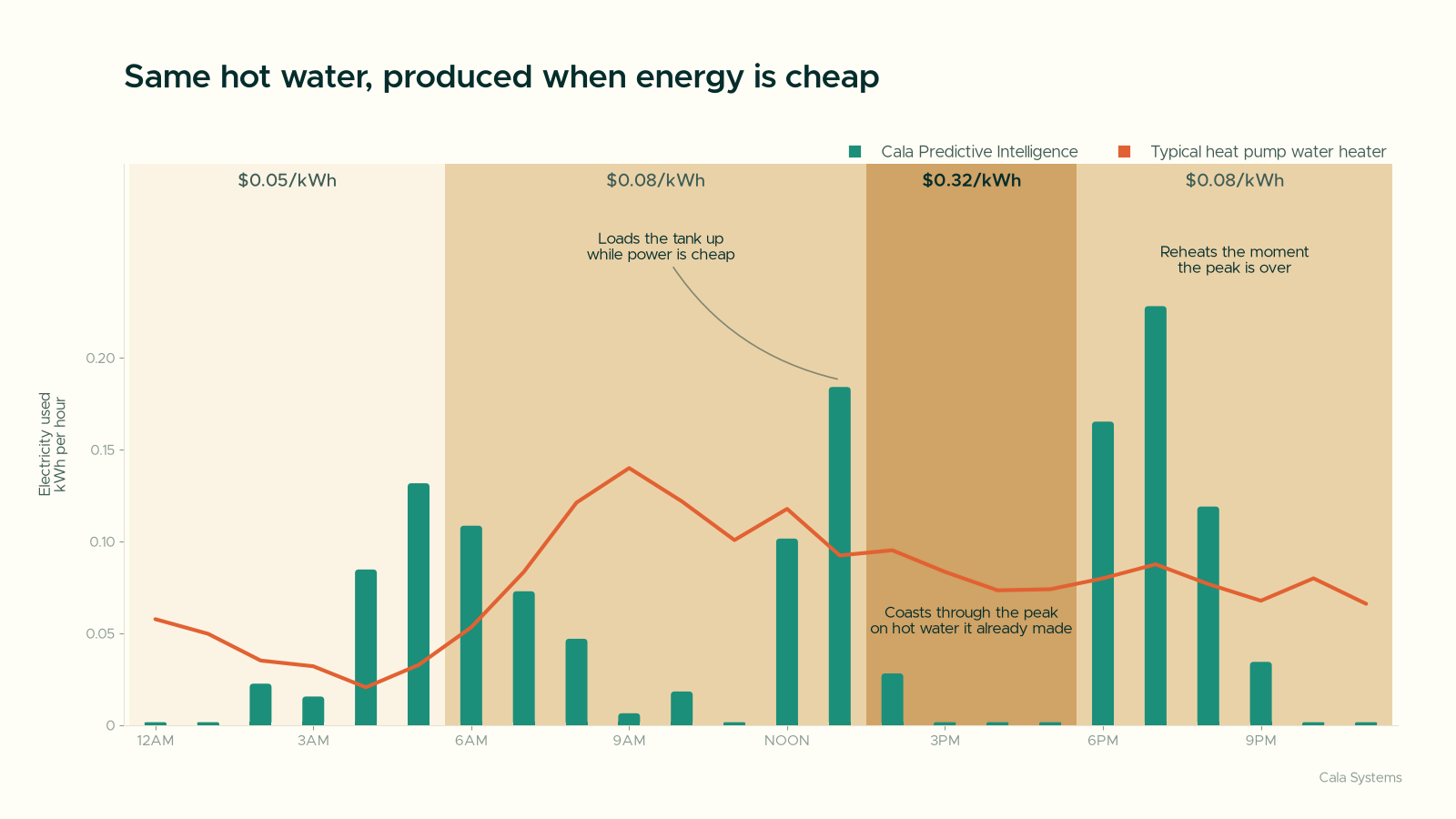
A recent analysis looked at three Cala water heaters operating on real multi-tier time-of-use rates. Their actual hourly energy use was priced under each home’s utility rate and compared with usage-matched Cala units operating with reactive controls under the same rates.

During the weeks analyzed, the three systems using Cala Predictive Intelligence cost 28% to 50% less to run than a heat pump water heater with traditional reactive controls. For a family of four, the potential savings over 10 years ranged from $900 to $2,500, depending on the average price of electricity and the structure of the TOU rates.
Cala Was Designed to Anticipate, Not Just React

Cala combines advanced controls, external data, and purpose-built hardware to determine when and how to heat water. It can coordinate with time-of-use electricity rates, learn a household’s hot water usage patterns, take advantage of solar production, and prepare for periods of peak demand.

Its variable-speed compressor and integrated mixing valve add flexibility, allowing the system to store more usable hot water when energy is less expensive or self-generated. Instead of simply consuming electricity whenever the tank gets cold, the water heater can help manage when that electricity is used.

Choose for the Home—and Rate Plan—You May Have Next

Most homeowners wouldn’t install an electrical panel that couldn’t support a future EV charger. They wouldn’t choose an HVAC system without considering how their home’s needs might change over the next decade.

Water heating deserves the same forward-looking mindset.

If you live in Arizona, California, Colorado, or Michigan, time-of-use rates are already mandatory or the default for many residential customers. Massachusetts and New York are transitioning more customers to default TOU rates, while Texas homeowners can choose among TOU plans in its deregulated electricity market. The specific options and requirements depend on your utility.

Solar can make this especially important. New solar customers in Arizona and California are required to use TOU rates alongside net billing, and many other states are moving away from traditional one-to-one net metering. That makes using solar energy when it is produced increasingly valuable.

An EV can also make a TOU plan attractive because charging overnight can reduce costs. At many utilities, the rate applies to the entire home—not only the vehicle—which means when your water heater runs matters, too.

If you are replacing a water heater and live in one of these states, have or are considering solar, or expect to purchase an EV, consider whether the new system can adapt as your home and electricity rate evolve.

A water heater may remain in your home for 10 to 15 years. Cala was built for the home—and the rate plan—you may have next.

Share this post
Cala Systems

The water heater you install today will likely still be in your home 10 to 15 years from now.

During that time, your home may change significantly. You might install solar panels, add battery storage, buy an electric vehicle, switch to a heat pump for heating and cooling, or enroll in a new utility rate program.

Your utility may change, too. Time-of-use rates are becoming more common, which means electricity can cost much more at some times of day than at others. Solar compensation policies are also evolving, often making it more valuable to use solar energy when it is produced rather than export it to the grid.

The question is no longer just whether your next water heater can provide enough hot water. It is whether it will be ready for the home—and the electricity rates—you may have five or ten years from now.

When You Use Electricity Matters

Under a time-of-use rate plan, electricity typically costs more during periods of high demand, such as late afternoons and early evenings, and less during off-peak hours, such as overnight.

Imagine two water heaters that each need the same amount of electricity to heat their tanks. One runs during an evening peak when electricity costs $0.40 per kWh. The other runs overnight at $0.03 per kWh. Both provide the same hot water, but one pays more than twice as much for the energy.

Most traditional water heaters cannot respond to that difference. When the tank temperature drops, they turn on. When it reaches the target temperature, they turn off. They do not know whether electricity is expensive, whether your solar panels are producing excess power, or whether a lower-cost period is a few hours away.

Your Water Heater Is Also Energy Storage

A hot water tank stores energy. By heating water when electricity is inexpensive, abundant, or produced by rooftop solar, an intelligent water heater can save that energy as hot water for later use.

That makes it possible to shift electricity use without asking homeowners to change when they shower, wash dishes, or do laundry. The goal is the same comfort, with more of the heating done at advantageous times.

What Early Real-World Data Shows

A recent analysis looked at three Cala water heaters operating on real multi-tier time-of-use rates. Their actual hourly energy use was priced under each home’s utility rate and compared with usage-matched Cala units operating with reactive controls under the same rates.

During the weeks analyzed, the three systems using Cala Predictive Intelligence cost 28% to 50% less to run than a heat pump water heater with traditional reactive controls. For a family of four, the potential savings over 10 years ranged from $900 to $2,500, depending on the average price of electricity and the structure of the TOU rates.

Cala Was Designed to Anticipate, Not Just React

Cala combines advanced controls, external data, and purpose-built hardware to determine when and how to heat water. It can coordinate with time-of-use electricity rates, learn a household’s hot water usage patterns, take advantage of solar production, and prepare for periods of peak demand.

Its variable-speed compressor and integrated mixing valve add flexibility, allowing the system to store more usable hot water when energy is less expensive or self-generated. Instead of simply consuming electricity whenever the tank gets cold, the water heater can help manage when that electricity is used.

Choose for the Home—and Rate Plan—You May Have Next

Most homeowners wouldn’t install an electrical panel that couldn’t support a future EV charger. They wouldn’t choose an HVAC system without considering how their home’s needs might change over the next decade.

Water heating deserves the same forward-looking mindset.

If you live in Arizona, California, Colorado, or Michigan, time-of-use rates are already mandatory or the default for many residential customers. Massachusetts and New York are transitioning more customers to default TOU rates, while Texas homeowners can choose among TOU plans in its deregulated electricity market. The specific options and requirements depend on your utility.

Solar can make this especially important. New solar customers in Arizona and California are required to use TOU rates alongside net billing, and many other states are moving away from traditional one-to-one net metering. That makes using solar energy when it is produced increasingly valuable.

An EV can also make a TOU plan attractive because charging overnight can reduce costs. At many utilities, the rate applies to the entire home—not only the vehicle—which means when your water heater runs matters, too.

If you are replacing a water heater and live in one of these states, have or are considering solar, or expect to purchase an EV, consider whether the new system can adapt as your home and electricity rate evolve.

A water heater may remain in your home for 10 to 15 years. Cala was built for the home—and the rate plan—you may have next.

latest ARTICLES

Cala + Home Assistant: Water Heating That Responds to Your Home

Read Article

Cala Pro Spotlight: SumZero Energy Systems (Mass)

Read Article

Cala’s Intelligent Heat Pump Water Heater is Now Certified

Read Article

Employee Spotlight : Dustin Cox, Southeast Territory Manager.

Read Article