

When Is a Heat Pump Water Heater Not Really a Heat Pump Water Heater? When it relies on electric resistance elements to do the heavy lifting.
That’s the core issue recently examined in a field study from Larson Energy Research (LER). The question was simple but important:
How much of a heat pump water heater’s (HPWH) energy is actually delivered by the heat pump versus the electric resistance elements?
To find out, LER analyzed six years of data from nearly 60 homes participating in the Northwest Energy Efficiency Alliance’s End Use Load Research project. The result was striking: On average, 35% of energy consumed by traditional HPWHs came from electric resistance heating.
For a technology designed to deliver major energy savings and reduce carbon emissions, that’s a surprisingly high number. Let’s take a closer look at what this means - and why it highlights a fundamental difference between traditional heat pump water heaters and Cala’s intelligent approach.
Digging Deeper: ER Input Fraction
To evaluate real-world HPWH performance, LER introduced a useful metric called ER Input Fraction: the percentage of a water heater’s total electrical consumption that comes from its resistance elements.
Lower is better - a low ER Input Fraction means more heating is being done by the heat pump, whereas a high ER Input Fraction means the system is relying more heavily on electric resistance heating. This is important because the heat pump is 3-5x more efficient at heating than the resistive elements, so it’s advantageous to use it as much as possible.
So why is the 35% figure so important?
Because it shows that many HPWHs are still behaving much more like conventional electric water heaters than most people realize. Traditional HPWHs operate reactively; they wait until water temperatures drop and then begin recovering. When demand is high - or when the heat pump can’t recover quickly enough - the resistance elements often activate to help catch up. Some operating modes even intentionally rely on resistance heat to prioritize recovery speed.
The result is that a substantial portion of water heating is still being delivered through the least efficient pathway. In other words, many heat pump water heaters spend a surprising amount of time not acting like heat pump water heaters.
Enter Cala
This is exactly the problem Cala’s intelligent HPWH was designed to solve.
Unlike traditional systems, Cala doesn’t simply react when water temperatures drop. It continuously learns each home’s hot water usage patterns and combines that information with other signals such as utility rates, solar production, weather forecasts, and homeowner preferences. Rather than waiting for demand to occur, Cala plans ahead.
By treating the water tank as a thermal battery, Cala can store heat when it is most efficient or advantageous to do so and make that energy available later when demand arrives. It does this by maximizing use of the heat pump’s variable speed compressor, and minimizing reliance on resistance elements - all without sacrificing hot water availability. And because Cala does this automatically, homeowners don’t need to manage complicated operating modes, schedules, or temperature settings.
As contractors and homeowners frequently tell us: “You shouldn’t have to think about your water heater.”
Comparing Cala to Current HPWHs
When we applied the same ER Input Fraction methodology to our own field fleet, the results were clear.
- Traditional HPWH (LER Study): 35%
- Cala - Learning Period (first 30 days): 12%
- Cala - After Predictive IntelligenceTM activates: 7%
Notably, Cala’s controls were significantly better than traditional systems even during the initial learning period, and once Predictive Intelligence™ kicks in, we reduce resistance usage even further. Cala also exceeded LER’s aspirational long-term industry target of 15%, demonstrating how we’re well ahead of the curve in delivering best-in-class performance.
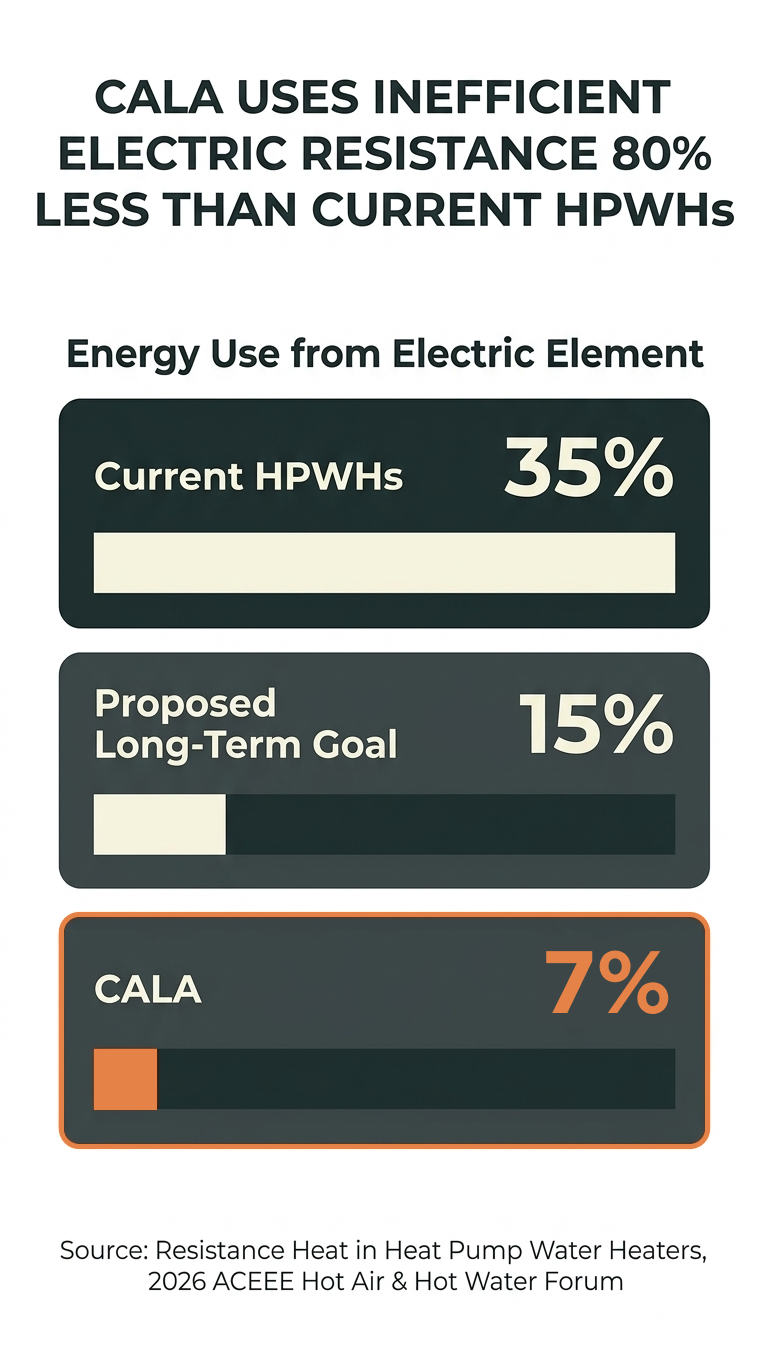
This is important because it demonstrates that the advantage is not simply a software feature layered onto a conventional design. Cala was engineered from the ground up to maximize heat pump operation and minimize resistance heating.
Efficiency Without Compromise
Of course, efficiency alone isn’t enough - the primary job of any water heater is delivering hot water when people need it. This creates an important challenge because heat pumps recover more slowly than resistance elements. How do you maximize heat pump operation without increasing the risk of running out of hot water?
Once again, the answer is prediction. By forecasting future hot water demand, Cala can prepare in advance rather than reacting after the fact.
Cala is also the first water heater capable of autonomously adjusting its heating temperature. By strategically heating water to higher temperatures when beneficial, Cala effectively increases the usable hot water available within the tank. Its integrated mixing valve then delivers safe, comfortable temperatures at the tap while allowing the system to store more thermal energy inside the tank.
The result is both higher efficiency and greater hot water availability: Across our fleet, Cala successfully met hot water demand in 99.8% of all hot water draws.
More Than Efficiency: Consistency
Another important takeaway from this comparison is consistency.
One of the most interesting findings in LER’s study was the enormous variation between homes. Some systems relied on resistance heat for the vast majority of their operation, while others performed much better. By contrast, nearly 80% of Cala systems operated at or below the 15% ER Input Fraction target identified by Larson as a desirable future state for the industry.
That matters because homeowners don’t buy average performance, they buy the system installed in their home. Our goal isn’t simply to achieve impressive efficiency in ideal conditions; our goal is to deliver that performance consistently across a wide range of homes, climates, and hot water usage patterns.
Bringing It Home
Heat pump water heaters represent the future of efficient water heating.
But the LER study highlights an important reality: today’s heat pump water heaters are leaving a substantial amount of efficiency on the table. When resistance elements provide a large share of the heating, much of the efficiency advantage is lost.
Cala was designed to address that challenge directly.
By using Predictive IntelligenceTM to anticipate demand, optimize heating decisions, and maximize heat pump operation, Cala dramatically reduces reliance on resistance heating while continuing to deliver the comfort homeowners expect.
The result is lower energy use, lower operating costs, reduced carbon emissions, and dependable hot water.
In short, it’s a heat pump water heater that actually acts like one.
See the study here


.jpg)